
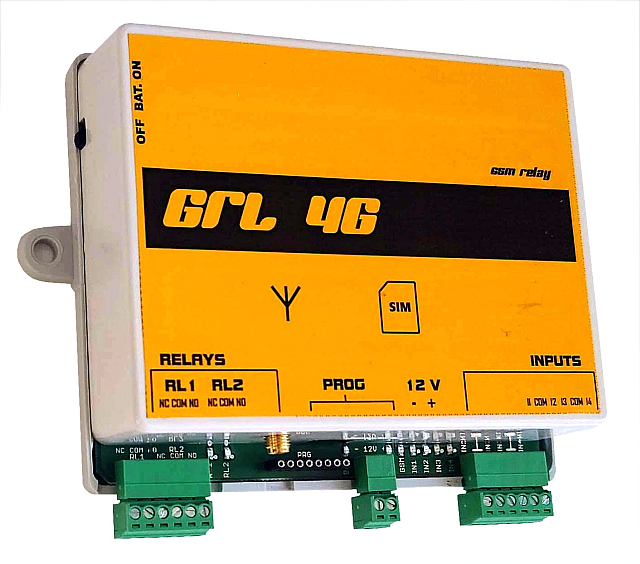
The "GRL 4G" – GSM voice relay with 4G/VoLTE support, 2 relays, and 4 inputs
It is used for remote control of two independent relays and for monitoring four inputs. When an input changes state (open/closed), it sends an alert SMS. It also supports voice calls with audio messages—when you call the unit, it announces the current status of the inputs and relays.
| Attachment | Size |
|---|---|
| EN-4G-GSM-Relay-datasheet | 670.57 KB |
| EN-4G-GSM-Relay-manual | 825.5 KB |
| Activity-monitoring-program | 356.72 KB |
The "GRL 4G" device is ideal wherever you need to remotely control equipment and simultaneously monitor statuses/faults via the mobile network—without requiring internet access on site.
Machine rooms, switchboards, and technical rooms:
Relays are typically used to switch circuits (e.g., lighting, ventilation, device reset), while inputs are used for fault contacts, service signals, or status outputs from equipment.
Boiler rooms and heat exchange/substation rooms:
Relays are used for remote start/stop or reset, while inputs monitor burner faults, safety thermostat trips, pressure switch signals, or door opening.
Pump sumps and water technology (pumps, level control):
Relays are used to control a pump/contactor (optionally via an interposing relay), while inputs connect to level switches, pump fault contacts, or overflow alarms.
WWTP (wastewater treatment plants) and small technology units:
Inputs are commonly connected to float switches (min/max level), blower/pump fault contacts, or overflow indication; relays are used for remote reset, mode switching, or switching an auxiliary circuit (typically via an interposing relay/contactor).
Garages and entrances (gates, barriers):
The relay is connected for pulse control of a gate/barrier, while inputs monitor open/closed status, drive faults, or emergency release.
Doors, gates, and access points:
Relays are used for unlocking/opening (typically by pulse), while inputs take signals from door contacts, locks, or opening sensors.
Emergency and operational statuses in buildings (intruder/fire systems, building technology):
Inputs connect to dry-contact outputs from alarm/fire systems or other subsystems (alarm/fault), while relays can trigger a follow-up action (e.g., reset, mode switching, indication).
Sites without stable internet (warehouses, containers, temporary buildings):
Relays typically control heating, lighting, or equipment, while inputs monitor door opening, power failure via an external contact, or status signals from simple sensors.
Cabins and holiday homes (no Wi-Fi, no internet):
Relays are used for remote enabling of frost protection/temperature maintenance, a water heater, a pump, or lighting (often via a contactor/interposing relay); inputs connect to door contacts, equipment fault contacts, level switches, or outputs from a simple security system.
For switching higher loads, the relay should be used only as a control contact—typically to drive a contactor or interposing relay (it is not intended for direct switching of high-power 230 V loads).
Backup and Parallel Layer for Critical Operations:
The GRL 4G device in Master–Slave configuration adds a separate backup or parallel layer to the main mission-critical solution for alarm transmission and triggering a defined action between remote sites. It is suitable for applications where higher operational resilience is required without complex cabling.
Typical applications:
- flood protection and drainage
- pumping and transfer pump stations
- retention tanks and water management facilities
- emergency activation of backup technologies
- shedding of non-critical loads
- activation of sirens, beacons, and warning devices
Notice: The GRL 4G is not a replacement for the main safety system. Its strength lies in complementing the existing infrastructure with a simple, separate, and practical backup layer.
Key features
- Replaceable backup battery (Li-Ion 2400 mAh)
- Easy installation and setup (basic setup requires only storing the ADMIN number on the SIM)
- When an input changes state (closed/open), it sends alert SMS messages to up to 7 phone numbers stored on the SIM (PORTOPN1–7 and PORTCLS1–7)
- Can call preprogrammed numbers and play an audio message with current status/alarm information
- 8 status SMS messages for inputs (4 inputs × closed/open)
- Configurable relay state after power-up: OFF / ON / remember the last state before power loss
- Remote status check of both relays, all inputs, temperature, and device power/battery status
- Control and programming only from phone numbers stored on the SIM (ADMIN1–ADMIN9)
- Operation without PIN / with PIN (PIN 0000); the device can automatically change the SIM PIN
Programming GRL 4G parameters via SMS
- For security, the GRL 4G parameters can be set only from numbers stored on the SIM as ADMIN1 to ADMIN9
- SMS commands must always be written IN CAPITAL LETTERS
- SMS parts are separated by a space: the first word is the command, the next word(s) are parameters
FAQ
What is GRL 4G, and what is it used for?
The GRL 4G is a GSM voice relay with 4G/VoLTE support for remote control of 2 relays and monitoring of 4 inputs. When a state changes, it can send SMS alerts and place calls with an audio message.
How does a 4G GSM relay work for remote control?
The relays can be controlled remotely using SMS commands. Depending on the relay mode setting, control by “ringing” (call trigger) from authorized numbers is also possible.
How many numbers can receive SMS input alarms?
Up to 7 phone numbers. Separate lists are used for input activation and deactivation: PORTOPN1–7 and PORTCLS1–7.
Can GRL 4G call and play a voice message during an alarm?
Yes. The unit can call preprogrammed numbers and play an audio message with status/alarm information. Calling the unit can also provide the voice status of relays and inputs.
How is device control and programming secured?
Control and configuration are allowed only from phone numbers stored on the SIM as ADMIN1 to ADMIN9.
How can I check relay/input/power status remotely?
By SMS query, you can remotely check the status of both relays, all inputs, temperature, and power/battery information.
Do I need internet or Wi-Fi on site?
No. The GRL 4G communicates via the mobile network (4G/VoLTE) and does not require internet connectivity on site.
Can I switch a 230 V load directly with the relay?
For higher loads, use the relay as a control contact—typically to drive a contactor or interposing relay (it is not intended for direct switching of high-power 230 V loads).
Inquiry system for business customers